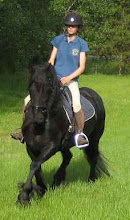
Spring has come early and a few of the horses are showing by being a little nutty...geldings in particular! I think it is in part that it is getting icy, but also because their is no Warrior to get them playing :) Boarders should consider free longing their horses if possible so they have non-ridden time to stretch their legs. I will be doing the same for any peppy lesson horses.
It also seems that working on lead changes and dealing with peppy ponies is taking up enough of the lesson that we aren't doing the challenge this week and instead doing the lead change exercise and then incorporating that into a simple jumping course.
I may move some of the horses around over the next week as well, so please be sure to check the white board to find your horse if it isn't where it normally is!
Wednesday, February 27, 2013


Monday, February 25, 2013
Dale Irwin coming to Hillside!
Keep Easter long weekend open, as I have confirmed that Dale Irwin will be coming to teach a three day clinic the last weekend in March. Dale is a top level eventing and dressage coach. Two years ago I rode Brie in a clinic with him and really appreciated his teaching style and ideas. I feel that his international level experience gives him the depth needed to be able to quickly assess issues, and give us the tools to progress.
(don't confuse Dale Irwin with Chris Irwin the "Natural Horsemanship" trainer)
The clinic will be available for riders to ride in two or three days of the clinic. Single days will only be available if time allows. Friday will be flat work/dressage, and Saturday/Sunday can be either flat or jumping.
This clinic is open to anyone, and even if you don't want to ride in it, you will likely learn a fair bit by watching. I am planning to jump Izzy in the clinic, so could be entertaining!
He is good at teaching all levels of riders and riders.
Rates still to be determined. If anyone is interested in subsidizing the clinic by helping with morning barn chores during the clinic OR by offering to host Dale for the weekend, please let me know!
Karen
(don't confuse Dale Irwin with Chris Irwin the "Natural Horsemanship" trainer)
The clinic will be available for riders to ride in two or three days of the clinic. Single days will only be available if time allows. Friday will be flat work/dressage, and Saturday/Sunday can be either flat or jumping.
This clinic is open to anyone, and even if you don't want to ride in it, you will likely learn a fair bit by watching. I am planning to jump Izzy in the clinic, so could be entertaining!
He is good at teaching all levels of riders and riders.
Rates still to be determined. If anyone is interested in subsidizing the clinic by helping with morning barn chores during the clinic OR by offering to host Dale for the weekend, please let me know!
Karen
Sunday, February 24, 2013
This week in lessons: flying changes & a new challenge
This week in lessons we will be working on lead changes. Advanced horses/riders will work on flying changes, while the less able horses and/or more novice riders will do simple changes. We actually worked on lead changes over the skinny pole two weeks ago when we were jumping the figure of eight, but this type we will do it with intent!
What is a lead change? A lead change is the horse changing from one canter lead to the other. There are two types of lead changes: Flying and Simple changes. In a flying change the horse maintains a canter and changes from one lead to the other without breaking the canter gait. In a simple change the horse is brought back to a trot or walk (or in Rocket's case a pace...), rebalanced, and then the other lead is picked up. Dressage uses the transition to walk as it requires balance and collection and will help with developing a dressage suitable flying change, whereas when jumping, a simple change will be through trot as it is less likely to take away the forward momentum.
Why is it important? In dressage, flying changes are required starting at 3rd level as a test of training and ability. For jumping, being on the correct lead around the horse will help the horse be better balanced through the turns. In hunters this is judged, and a horse going around on the wrong lead, or even worse, disunited, will be heavily penalized (although the ideal in jumpers is to have the horse land the correct leads as it looks smoother). In jumpers this is not judged, so some riders may allow the horse to be on the "wrong" lead if that is the lead it is stronger on.
(disunited is when the horse is on two different leads on the front end vs the back end)
Dressage vs Jumping lead changes:
A dressage flying lead change is born out of collection with the horse able to "skip" from one lead to the other through increases suspension. The foot falls going from left lead to right lead would be:
RH/LH+RF/LF, (moment of increased suspension), LH/RH+LF/RF, so the horse sort of skips on the LH. This requires the horse to have good strength in its haunches as well as enough time in the air (suspension) to be able to swap the hind legs around.
A hunter flying change is different as the horse needs to maintain a forward flow, and the same amount of precision is not needed. Although some horses will still do their flying change with the same footfalls as for a dressage change, it is also possible for them to take a stride or two to complete the change without penalty by a judge. A typical flying change for a hunter will involve the front end changing first, and the hind end changing the very next stride. This is the kind of lead change we will be working on this week.
Here are some examples of horses schooling flying changes using the methods we will be using. Both these horses are new to flying changes.
Izzy Flying changes with a ground pole to assist
Coregel flying changes without poles to help.
With both horses I am trying to get the lead change before the corner, but still using the approaching wall/corner to help set them up. I am also trying to be light on their backs to encourage the increased suspension, and not worrying too much if they get quick, as this will also help them achieve the lead change.
Please note, there are many ways to school flying changes and this is just one of them!
Aids I am using for the left to right lead change:
Turning across the diagonal with as straight a horse as possible (through the neck), I am light in my seat, but have a fair bit of right leg back and on, similar to how I would ask for a leg yield to the left. If I do get a bit of sideways motion that is fine. As I get to the pole (or second quarterline if not using a pole), I swap and put my right leg on/back and may give take with my new inside hand/rein, but again, the aids are similar to a leg yield, only this time to the right. Important the neck stays mostly straight!
I make sure to focus on the goal (flying change) and if my horse gets a little quick I am ok with that. If using a pole I WANT the long if there is an option as they are more likely to stretch into the change this way.
Now...the test...can anyone tell me why using a pole is unlikely to get you a "true" lead change?
Answer: If you watch the videos, you can see that for other that Coregel's last try, both horses are getting the change in the front first, and then catching up with the hind end. The pole encourages this as the suspension created is first created in the front as the horse goes over the pole, then the hind end. (Coregel is doing this despite the pole as it is easier and requires less hind end strength) This would be completely acceptable in the hunters, but a low score for dressage. Still, it gives the horse an idea of what is expected and useful for teaching either discipline.
Now for simple changes through trot:
When trying for a simple change through trot, make sure your horse comes back to a clear two beat trot, rebalance, change the bend, and ask for the new lead. Do not let the horse rush or anticipate, and if they start to, then just keep trotting. Simple changes through trot are acceptable in low level hunter competitions, although the equal round with flying changes or landed leads will usually win. What you want to avoid though, is the horse that is thinking simple change in every corner, as if the horse is thinking "Trot" it would be creating the suspension and forward needed for a flying change (think of Rocket or Spencer)
For the new challenge this week we will be doing a "make your own course challenge". This will be timed using poles and jumps, with rider's needing to come up with the best/quickest way for their horse to complete the horse. Trying to help rider's think logically and assess their horse's weaknesses and strengths as well as their own.
(last week's challenge was only achieved by two horse/rider combinations; Laureen with Percy and Amber with Kokanee!)
Karen
Wednesday, February 20, 2013
For the dressage riders...
Dressage judges are encouraged to always put something positive in their comments at the end of the test. While scribing last year I realized that this is usually not hard as there is usually some redeaming qualities, but for certain tests it can be quite a stretch to come out with something nice to say, so I found this article very funny and apt!
http://www.chronofhorse.com/article/nice-braids
http://www.chronofhorse.com/article/nice-braids
Monday, February 18, 2013
This week in lessons & new challenge!
This week in lessons we are continuing to work on perfecting the leg yield with the horse facing away from the wall (as per previous youtube videos!). This is going to flow into next week's lesson which will use these skills to work on flying lead changes.
For jumping, we are going to work on jumping a skinny with no standards. This will use similar skills that riding the horses at the ball used: keeping the horse between hand and leg and controlling their body and in particular, their shoulders.
We also have a new challenge this week: it will be an obstacle course. This won't be timed, but rather scored based on success negotiating the horse with minimal pylon tragedies and hooves outside the course. This course will include:
- The above mentioned skinny jump
- bending line with set number of strides
- trot after a jump (before pylon markers)
- Turn on the forehand inside a pole "box"
- Horse and rider touching the ball.
- precise corner through pylon markers.
Also planning a barn party for Saturday the 3rd of March at 12:30. A simple get together so riders/boarders can meet each other, and also so we can discuss what shows we want to go to and such. Details to be determined but thinking potluck lunch type food? Would a March gift exchange be weird? Oh, and an awards ceremony for the winners of the lesson challenges! Let me know if you can attend asap so I know if I need to switch days.
For jumping, we are going to work on jumping a skinny with no standards. This will use similar skills that riding the horses at the ball used: keeping the horse between hand and leg and controlling their body and in particular, their shoulders.
We also have a new challenge this week: it will be an obstacle course. This won't be timed, but rather scored based on success negotiating the horse with minimal pylon tragedies and hooves outside the course. This course will include:
- The above mentioned skinny jump
- bending line with set number of strides
- trot after a jump (before pylon markers)
- Turn on the forehand inside a pole "box"
- Horse and rider touching the ball.
- precise corner through pylon markers.
Also planning a barn party for Saturday the 3rd of March at 12:30. A simple get together so riders/boarders can meet each other, and also so we can discuss what shows we want to go to and such. Details to be determined but thinking potluck lunch type food? Would a March gift exchange be weird? Oh, and an awards ceremony for the winners of the lesson challenges! Let me know if you can attend asap so I know if I need to switch days.
Tuesday, February 12, 2013
The leg yield exercise
Last week we worked on leg yield with the horse angled away from the wall. A few of you progressed from that to asking for shoulder in. Alternatively a few of you found this mind boggling requiring me to demonstrate by getting down on all fours...
It occurred to me that a video demonstration might assist as we are going to try this again next week.
Why the focus on leg yield? Leg yielding is required in first level dressage as it shows the horse's ability and willingness to move laterally off of leg, and maintain a semblance of straightness and forwardness. For jumping, have a horse that moves laterally off of leg can help with issues of straightness, to push a horse into the corners better, and will also progress to flying lead changes.
By doing the leg yield at an angle away from the wall, the rider must focus on fine control of how much sideways, and how much forward the horse is able to do. The achievement is measurable as you can see the angle achieved, and measure how far off the wall you ended up coming!
For Izzy, this exercise will help her shoulder in; she tends to want to pop her shoulder to the wall rather than maintain a true bend; by going from this leg yield to the shoulder in, and back to this leg yield, I am forced to maintain control of the shoulder.
Here is the video of Izzy
Try to see where I switch from leg yield to shoulder in and back again. In Leg Yield, front and back legs cross, and the horse should be straight in the body, with just a slight flex in at the jaw. In Shoulder in, her hind legs should not cross as her hind quarters should be parallel to the wall, and she should have bend through her body. Note how she resists by bringing her head up, and how I respond by kicking, and asking her to give with her jaw by give and take with that inside rein.
I am trying to get a clear four track leg yield from her (inside legs travel on a track inside the hinds) but she is not wanting to do this, and I can only get a few good steps as she really wants to pop out with her shoulder!
Now here is Coregel
Note how I am able to get Coregel on four clear tracks. This is easier on her vs. Izzy because she is a stiffer horse front to back, and popping her shoulder out isn't something she wants to do! I have done a slow motion take and hopefully you can see where I go from leg yield to a step or two of shoulder in, and back to leg yield a couple times. I only do a step or two of shoulder in on Coregel as she is just getting back into work, and more than a couple steps of shoulder in would be unfair to an unfit and slightly fat equine, and would only encourage her to evade.
What I am not sure you can see with either horse, is that although the inside leg is the one asking for the leg yield, the outside leg is also back and ready to tap tap tap to regain the forward. Note too, that I am restricting with my hands so that the energy I am creating goes up and across, and not scrambling and forward.
Hopefully this increases some understanding of the exercise so we have more success next week!
Karen
It occurred to me that a video demonstration might assist as we are going to try this again next week.
Why the focus on leg yield? Leg yielding is required in first level dressage as it shows the horse's ability and willingness to move laterally off of leg, and maintain a semblance of straightness and forwardness. For jumping, have a horse that moves laterally off of leg can help with issues of straightness, to push a horse into the corners better, and will also progress to flying lead changes.
By doing the leg yield at an angle away from the wall, the rider must focus on fine control of how much sideways, and how much forward the horse is able to do. The achievement is measurable as you can see the angle achieved, and measure how far off the wall you ended up coming!
For Izzy, this exercise will help her shoulder in; she tends to want to pop her shoulder to the wall rather than maintain a true bend; by going from this leg yield to the shoulder in, and back to this leg yield, I am forced to maintain control of the shoulder.
Here is the video of Izzy
Try to see where I switch from leg yield to shoulder in and back again. In Leg Yield, front and back legs cross, and the horse should be straight in the body, with just a slight flex in at the jaw. In Shoulder in, her hind legs should not cross as her hind quarters should be parallel to the wall, and she should have bend through her body. Note how she resists by bringing her head up, and how I respond by kicking, and asking her to give with her jaw by give and take with that inside rein.
I am trying to get a clear four track leg yield from her (inside legs travel on a track inside the hinds) but she is not wanting to do this, and I can only get a few good steps as she really wants to pop out with her shoulder!
Now here is Coregel
Note how I am able to get Coregel on four clear tracks. This is easier on her vs. Izzy because she is a stiffer horse front to back, and popping her shoulder out isn't something she wants to do! I have done a slow motion take and hopefully you can see where I go from leg yield to a step or two of shoulder in, and back to leg yield a couple times. I only do a step or two of shoulder in on Coregel as she is just getting back into work, and more than a couple steps of shoulder in would be unfair to an unfit and slightly fat equine, and would only encourage her to evade.
What I am not sure you can see with either horse, is that although the inside leg is the one asking for the leg yield, the outside leg is also back and ready to tap tap tap to regain the forward. Note too, that I am restricting with my hands so that the energy I am creating goes up and across, and not scrambling and forward.
Hopefully this increases some understanding of the exercise so we have more success next week!
Karen
Monday, February 11, 2013
Not at all horse related
Somehow I am on the Conservative Party emailing list. I am fine with that, because I think for democracy to work, we actually do have to participate and get our opinions to the decision makes, and what easier way than through surveys?
If you want to participate in the govermental surveys, this is the link:
http://www.conservative.ca/yourvoice
(they wanted me to email 5 friends, but I thought this might be a better format)
Yes, I wish the questions could be worded less leadingly, but democracy isn't perfect.
My last survey ended in a rant about the education system.
Karen
If you want to participate in the govermental surveys, this is the link:
http://www.conservative.ca/yourvoice
(they wanted me to email 5 friends, but I thought this might be a better format)
Yes, I wish the questions could be worded less leadingly, but democracy isn't perfect.
My last survey ended in a rant about the education system.
Karen
Sunday, February 10, 2013
This week's Challenge!
I have a challenge for all lesson students and boarders who wish to participate. There may be a prize for the top three challengers!
Time to beat is Izzy at 11 seconds.
The challenge? Push the soccer ball through the "goal". The horse will start from three meters away, and have to push the ball three meters through the pylons that will be set three meters apart.
Video of Izzy's attempt
Of course it won't always go that relatively smoothly, so to show the other extreme:
Video of Coregel's attempt
Now Coregel was nervous from the get go today, so had I wanted this to go easier I should have let her trot/canter around a bit to get some of her energy out, but I wanted to show how it COULD go, and how to recover.
Ideally I wouldn't have let her go past the ball, and had her stand in front of it until she relaxed (like when a horse tries to run out at a jump), but she was too agitated so instead I allowed the small circles, but did not let her leave the general area.
Her little rears are the same avoidance behaviours she exhibited when I tried to show her at an arena with cows way off in the distance, so it is good to be able to work her through the same type of pressure situation. Rearing happens when a horse feels trapped...in this case she feels like I am sending her into an immovable object (in the video the ball, at the show it was being within half a km of a cow...)...so we need to work on trust. As you can see once she figures out the ball moves, she relaxes considerably.
Aside from building trust and being entertaining, this exercise, and the follow up exercises will help riders think about how to control the horse's body, hopefully without over thinking it!
Some hints:
- Try to keep the horse's nose pointed at the ball, but hold the opposite rein enough that you don't loose the other shoulder.
- To be able to aim the ball, the horse's hips have to be lined up behind the shoulders and pointed at the ball...it isn't enough just to aim the nose. Use the same skills you would to do a turn on the forehand (leg back) to control the angle/aim.
- If you feel the horse getting agitated, either allow them to stop, or allow them to do a smaller circle. Do not praise them to try to relax, but just sit passively to give them time to relax. Only praise when you make gains...which may be just halted facing the ball, or (hopefully) when the horse pushes the ball.
And no cheating...the horse has to push the ball!
Karen
Time to beat is Izzy at 11 seconds.
The challenge? Push the soccer ball through the "goal". The horse will start from three meters away, and have to push the ball three meters through the pylons that will be set three meters apart.
Video of Izzy's attempt
Of course it won't always go that relatively smoothly, so to show the other extreme:
Video of Coregel's attempt
Now Coregel was nervous from the get go today, so had I wanted this to go easier I should have let her trot/canter around a bit to get some of her energy out, but I wanted to show how it COULD go, and how to recover.
Ideally I wouldn't have let her go past the ball, and had her stand in front of it until she relaxed (like when a horse tries to run out at a jump), but she was too agitated so instead I allowed the small circles, but did not let her leave the general area.
Her little rears are the same avoidance behaviours she exhibited when I tried to show her at an arena with cows way off in the distance, so it is good to be able to work her through the same type of pressure situation. Rearing happens when a horse feels trapped...in this case she feels like I am sending her into an immovable object (in the video the ball, at the show it was being within half a km of a cow...)...so we need to work on trust. As you can see once she figures out the ball moves, she relaxes considerably.
Aside from building trust and being entertaining, this exercise, and the follow up exercises will help riders think about how to control the horse's body, hopefully without over thinking it!
Some hints:
- Try to keep the horse's nose pointed at the ball, but hold the opposite rein enough that you don't loose the other shoulder.
- To be able to aim the ball, the horse's hips have to be lined up behind the shoulders and pointed at the ball...it isn't enough just to aim the nose. Use the same skills you would to do a turn on the forehand (leg back) to control the angle/aim.
- If you feel the horse getting agitated, either allow them to stop, or allow them to do a smaller circle. Do not praise them to try to relax, but just sit passively to give them time to relax. Only praise when you make gains...which may be just halted facing the ball, or (hopefully) when the horse pushes the ball.
And no cheating...the horse has to push the ball!
Karen
Tuesday, February 5, 2013
Monday, February 4, 2013
This week
This week is going to be nice weather wise, so hopefully the roads stay clear and we can have a good week of lessons!
Although yesterday afternoon was filled with the whining drone of snowmobiles, and had me wishing for 20 below again....
Dressage lessons will work on Shoulder fore and lengthenings (shoulder for for a few strides, then lengthening to ensure the horse is still active in the trot!)
Dressage and jumping will work on true bend and counter bend exercises.
Jumping will be doing a course again, and really focusing on using the ends of the arena to hit the "reset" button to rebalance the horse and get back the needed course pace (either increase or decrease).
We will also be trying to get the horse's to push the soccer ball while riding...just make sure you don't push it at another horse until they get used to seeing it move!
Karen
Although yesterday afternoon was filled with the whining drone of snowmobiles, and had me wishing for 20 below again....
Dressage lessons will work on Shoulder fore and lengthenings (shoulder for for a few strides, then lengthening to ensure the horse is still active in the trot!)
Dressage and jumping will work on true bend and counter bend exercises.
Jumping will be doing a course again, and really focusing on using the ends of the arena to hit the "reset" button to rebalance the horse and get back the needed course pace (either increase or decrease).
We will also be trying to get the horse's to push the soccer ball while riding...just make sure you don't push it at another horse until they get used to seeing it move!
Karen
Tuesday, January 29, 2013
Today
Today's 630 lesson is cancelled. Just too freaking cold for most sane people to want to drive out, and for the horses to get warm. I am willing to teach at 730 if anyone does want a lesson.
I have also definately added a 530 lesson on Thursday for make up lesson purposes, so if anyone wants to move their time up from 630 to 530 to allow others to ride later, that would be great.
I just came back in from giving them some extra hay, and the horses are all fine; the geldings were mostly in the shelters, but the mares were mostly out and about. Not sure if the barn and hill protects the mares better from the wind, or if they are just tougher/better dressed!
This morning and last night were a little bit of a shock to the system. I figured the worst part for me would be driving the Mule out back to dump the manure...I was right, but mostly because I was so bundled up I couldn't see very well and ran aground on a ridge of ice buried under the drifting snow! The back tires weren't even weight bearing.
Not to sound wimpy, but it IS a pretty long walk back to the barn to get a shovel for ice breaking purposes, so first I tried to lift the Mule off the ice (that was stupid), then I tried to chisel the ice with a screwdriver (less stupid, but not getting me very far very quickly either), before opting to walk back. The geldings watched my approach like I was a monster from the dugout, but once I retrieved the shovel, chipping the Mule free only took 15 minutes or so.
The entire time I am thinking...I wonder which horse I could harness up, slap on the ass, and haul this bloody thing free? (Wiley or Wolfgang were my top two picks)
Anyway, stay warm, keep safe, and know your horses are fine (albeit likely now moving on to fence destruction as is their favourite cold weather past time)
Karen
I have also definately added a 530 lesson on Thursday for make up lesson purposes, so if anyone wants to move their time up from 630 to 530 to allow others to ride later, that would be great.
I just came back in from giving them some extra hay, and the horses are all fine; the geldings were mostly in the shelters, but the mares were mostly out and about. Not sure if the barn and hill protects the mares better from the wind, or if they are just tougher/better dressed!
This morning and last night were a little bit of a shock to the system. I figured the worst part for me would be driving the Mule out back to dump the manure...I was right, but mostly because I was so bundled up I couldn't see very well and ran aground on a ridge of ice buried under the drifting snow! The back tires weren't even weight bearing.
Not to sound wimpy, but it IS a pretty long walk back to the barn to get a shovel for ice breaking purposes, so first I tried to lift the Mule off the ice (that was stupid), then I tried to chisel the ice with a screwdriver (less stupid, but not getting me very far very quickly either), before opting to walk back. The geldings watched my approach like I was a monster from the dugout, but once I retrieved the shovel, chipping the Mule free only took 15 minutes or so.
The entire time I am thinking...I wonder which horse I could harness up, slap on the ass, and haul this bloody thing free? (Wiley or Wolfgang were my top two picks)
Anyway, stay warm, keep safe, and know your horses are fine (albeit likely now moving on to fence destruction as is their favourite cold weather past time)
Karen
Sunday, January 27, 2013
Sucky Weather week forcast
Sounds like we are in for some nasty weather this week. The tri-fecta of cold, wind AND snow.
It looks likely that lessons will be cancelled on Wednesday, and possibly on Tuesday. Thursday sounds like an odd weather day, with it going from ridiculously cold, to oddly warm, so I am willing/able to add a 5:30 lesson, and take some extra students in the 7:30 lesson if people want to move their lesson to Thursday (assuming your horse is available to be ridden that day of course!)
Really tired of this up and down weather pattern, although I guess it is better than just staying cold. If you plan to ride your horse or do a lease ride on the really cold days, make SURE you are able to cool and dry the horse completely before turning it out. If I do teach lessons on the coldish days they will be such that they are easy on the horse...which usually means things that are harder on the rider....no stirrups perhaps?
I have the vet(s) booked for a few Fridays in Feb to do dental work and anything else that is needed. Please let me know asap if you want your horse looked at/worked on. If you have a Friday off in Feb, I could likely also use some help!
Vaccinations will be done in March.
Karen
It looks likely that lessons will be cancelled on Wednesday, and possibly on Tuesday. Thursday sounds like an odd weather day, with it going from ridiculously cold, to oddly warm, so I am willing/able to add a 5:30 lesson, and take some extra students in the 7:30 lesson if people want to move their lesson to Thursday (assuming your horse is available to be ridden that day of course!)
Really tired of this up and down weather pattern, although I guess it is better than just staying cold. If you plan to ride your horse or do a lease ride on the really cold days, make SURE you are able to cool and dry the horse completely before turning it out. If I do teach lessons on the coldish days they will be such that they are easy on the horse...which usually means things that are harder on the rider....no stirrups perhaps?
I have the vet(s) booked for a few Fridays in Feb to do dental work and anything else that is needed. Please let me know asap if you want your horse looked at/worked on. If you have a Friday off in Feb, I could likely also use some help!
Vaccinations will be done in March.
Karen
Monday, January 21, 2013
This week in lessons
I was thinking the other day of major hurdles when it comes to riding.
An early hurdle is learning to post the trot...once you learn though, it seems simple and odd that you ever couldn't post the trot.
A more advanced hurdle, one that many pleasure type riders never try to accomplish is what we will be working on this week. This is the hurdle of connection.
Connection can mean many things, but lets take it to mean at the most basic level; that the horse is ready to listen and obey reins and legs without more than a moments hesitation.
The problem is, keeping the horse in a connected state takes work and attention to the horse, although just like posting, once you GET IT, you can't figure out why it was so hard before!
To help with the connection issue, we have two things planned;
1) If you did not take part in the Centered riding clinic, I will want to spend 5 minutes with you either before or after your lesson to do a little exercise to develop a following and compassionate hand. If you did take the clinic, but want to do this again, by all means!
2) We are going to work on the lengthened trot. Not a faster trot. Not a rushed trot. A LENGTHENED trot. This means the horse stretches its poll forward, stretches its back longer, and reaches in longer steps. The rhythm should stay the same.
How do we get a lengthened trot? It is easy. You soften your hands down towards the horse's mouth, and soften your leg aids, and ALLOW IT.
Of course first you have to prepare for it...and this means a horse that is wanting to go slightly faster than you are asking, but not in a rushy way, but in a "at the ready" way. The horse has to already be flexed at the pole, straight through the body, and have a good rhythm. The horse has to be in a calm way, but not super relaxed as you need some tension to get a lengthen. A good lengthened trot is a moderate change...nothing exciting like you see at the Olympics, but you should feel the horse float a bit...kind of like when going over slightly long trot poles.
For the Saturday lessons I did a demo to show what I wanted and meant. I am willing to do this in lessons this week as well if requested.
For jumping we are going to ride lines of different lengths to work on adjustability in the jumping horses.
Karen
An early hurdle is learning to post the trot...once you learn though, it seems simple and odd that you ever couldn't post the trot.
A more advanced hurdle, one that many pleasure type riders never try to accomplish is what we will be working on this week. This is the hurdle of connection.
Connection can mean many things, but lets take it to mean at the most basic level; that the horse is ready to listen and obey reins and legs without more than a moments hesitation.
The problem is, keeping the horse in a connected state takes work and attention to the horse, although just like posting, once you GET IT, you can't figure out why it was so hard before!
To help with the connection issue, we have two things planned;
1) If you did not take part in the Centered riding clinic, I will want to spend 5 minutes with you either before or after your lesson to do a little exercise to develop a following and compassionate hand. If you did take the clinic, but want to do this again, by all means!
2) We are going to work on the lengthened trot. Not a faster trot. Not a rushed trot. A LENGTHENED trot. This means the horse stretches its poll forward, stretches its back longer, and reaches in longer steps. The rhythm should stay the same.
How do we get a lengthened trot? It is easy. You soften your hands down towards the horse's mouth, and soften your leg aids, and ALLOW IT.
Of course first you have to prepare for it...and this means a horse that is wanting to go slightly faster than you are asking, but not in a rushy way, but in a "at the ready" way. The horse has to already be flexed at the pole, straight through the body, and have a good rhythm. The horse has to be in a calm way, but not super relaxed as you need some tension to get a lengthen. A good lengthened trot is a moderate change...nothing exciting like you see at the Olympics, but you should feel the horse float a bit...kind of like when going over slightly long trot poles.
For the Saturday lessons I did a demo to show what I wanted and meant. I am willing to do this in lessons this week as well if requested.
For jumping we are going to ride lines of different lengths to work on adjustability in the jumping horses.
Karen
Monday, December 31, 2012
A project for winter

So not sure why the picture is sideways, but this is the project for winter! A big red ball, courtesy of Margie as a Christmas present. Margie and Roberta put the effort into inflating it (which was quite a task in itself), after which we rolled it outside along the gelding paddocks. This was cause for a great deal of excitement! It may not have helped that there was a very frustrated little dog pushing the ball around in the snow barking in frustration as she couldn't pick it up...but the geldings all swarmed like fish as Margie commented, in unified fear of the big red ball. Well, all except for Wolfgang who used the distraction to get a prime spot at the round bale feeder. Even cookies could not entice the horses to come closer!
As you can see, Wiley seems to have made peace with the ball, as has Shawn, but Magnus almost sits down if I roll it by his stall!
I figure step one is to get the horses comfortable having the ball around, and then we will worry about teaching them to push it, then to push it through an obstacle course, with the ultimate goal of teaching them horse soccer. My hope is that this will help certain unbrave equines to learn to face their fears, and also to work on precise steering and body control. Plus, it will be fun I think!
Karen
Sunday, December 30, 2012
This week in lessons
This week in lessons I am teaching Monday afternoon, Tuesday afternoon, and Wed/Thurs evening, as well as regular lessons on Sat. I am willing to teach during the day on Wednesday as well if anyone is interested.
More work compiling video of position over fences; once I have it all together I will make sure everyone gets a copy for their own use/viewing. This week I will try to set fences that will set you up to take long and short distances, so we can analyse the adaptability of your positions in the air.
I hope everyone is enjoying the warmer weather! The cats were happy to be able to wander about outside yesterday...although Charlie wandered all the way back to the house last night, meaning I had to lug him all the way back to the barn for the night...our black and white house cat really does not like him!
Also wanted to announce the official new addition of Wiley! Margie's new and obnoxious riding partner. He is out with Shawn and Rocket. He is a but of a shark when it comes to cookies, so beware! Magnus was fascinated with him for the first few days, but seems to have relaxed about his presence.
Karen
More work compiling video of position over fences; once I have it all together I will make sure everyone gets a copy for their own use/viewing. This week I will try to set fences that will set you up to take long and short distances, so we can analyse the adaptability of your positions in the air.
I hope everyone is enjoying the warmer weather! The cats were happy to be able to wander about outside yesterday...although Charlie wandered all the way back to the house last night, meaning I had to lug him all the way back to the barn for the night...our black and white house cat really does not like him!
Also wanted to announce the official new addition of Wiley! Margie's new and obnoxious riding partner. He is out with Shawn and Rocket. He is a but of a shark when it comes to cookies, so beware! Magnus was fascinated with him for the first few days, but seems to have relaxed about his presence.
Karen
Sunday, December 23, 2012
This week in lessons
By the looks of the weather forecast, this is going to be one nasty week of weather! Hopefully the roads improve so everyone can visit friends and family safely over the Holidays.
For lessons, I will be teaching Monday and Wednesday morning only, and then back to evening lessons on Thursday, although I am open to teaching a daytime lesson on Thursday as well. Let me know if you want to switch your times! It will still be cold during the day, but the sun seems to make it more bearable.
Lessons will be kept simple this week, with a continued focus on position/equitation, and I will be doing more videoing.
I hope everyone has a good Holiday and is able to spend Christmas with people that they care about.
Karen
For lessons, I will be teaching Monday and Wednesday morning only, and then back to evening lessons on Thursday, although I am open to teaching a daytime lesson on Thursday as well. Let me know if you want to switch your times! It will still be cold during the day, but the sun seems to make it more bearable.
Lessons will be kept simple this week, with a continued focus on position/equitation, and I will be doing more videoing.
I hope everyone has a good Holiday and is able to spend Christmas with people that they care about.
Karen
Thursday, December 20, 2012
Big Bang Theory fans?
Apparently the actress who plays "Penny" is quite a good rider and has four of her own horses:
http://www.self.com/healthystars/2013/01/big-bang-theory-kaley-cuoco-slideshow?intcid=homepage1220_2#slide=5
Pretty impressive equitation over a good sized fence!
http://www.self.com/healthystars/2013/01/big-bang-theory-kaley-cuoco-slideshow?intcid=homepage1220_2#slide=5
Pretty impressive equitation over a good sized fence!
Monday, December 17, 2012
Lessons and Christmas Break
I have not yet decided what days I will be taking off over the Holidays, so am looking for feedback as to who is away, and who is available to ride during the daytime rather than the evenings. Thought some "horse switching" lessons might be fun over the holidays as well.
This week in lessons we will be continuing to work on position over fences, and I will bring the camera out to get still shots of riders so we can better assess areas of improvement. If you wish to bring your own camera, feel free! Lots of two point to build the base of support as well. I like two point as a riding fitness exercise vs riding without stirrups as I think the latter makes people tight/stiff, which is not what I want.
This week in lessons we will be continuing to work on position over fences, and I will bring the camera out to get still shots of riders so we can better assess areas of improvement. If you wish to bring your own camera, feel free! Lots of two point to build the base of support as well. I like two point as a riding fitness exercise vs riding without stirrups as I think the latter makes people tight/stiff, which is not what I want.
Friday, December 14, 2012
Not sure if it is sad or funny...
In the last 30 days or so, I was interested in two separate horses, but before the seller had a chance to even show me the horse, the price increased. Now sometimes prices increase because the horse goes to a show, learns a new skill, or shows an aptitude for something of value, but in both these cases the horse hadn't even been ridden between price A and price B.
The interesting thing? Both horses are still for sale.
Both sellers and a potentially interested buyer, got greedy, and now have "must sell!" ads up.
Now the one horse is at a barn with no arena and seller has NO trailer, so when the cold hit, she lost her chance to sell me her horse...and likely anyone else...as who wants to try a horse out in the snow, with the weather we have been having? The other horse is further out, no arena, but seller has a trailer...not really sure why that one hasn't sold, but I have decided to wait until I see if Margie's horse works out, and get Gody sold before I should really shop anymore, so that person lost their window of opportunity to sell to me as well.
Greed doesn't pay. And when someone tells you that your horse is priced to low, offer to let them buy the horse rather than up your price and piss of that ready buyer!
The interesting thing? Both horses are still for sale.
Both sellers and a potentially interested buyer, got greedy, and now have "must sell!" ads up.
Now the one horse is at a barn with no arena and seller has NO trailer, so when the cold hit, she lost her chance to sell me her horse...and likely anyone else...as who wants to try a horse out in the snow, with the weather we have been having? The other horse is further out, no arena, but seller has a trailer...not really sure why that one hasn't sold, but I have decided to wait until I see if Margie's horse works out, and get Gody sold before I should really shop anymore, so that person lost their window of opportunity to sell to me as well.
Greed doesn't pay. And when someone tells you that your horse is priced to low, offer to let them buy the horse rather than up your price and piss of that ready buyer!
Monday, December 10, 2012
Wow I have been tired...
Not sure if it was the cold, or the clinic, but I have been absolutely exhausted lately. Hoping this week's warmer weather will re-energize me!
This week in lessons we are going to continue to explore some of the imagery that was touched on at the clinic. When I figure out what seems to help the most people I will write it all out so that everyone knows the new terms and I can add it to my teaching repertoire.
I am also going to try to adapt some of the flat work imagery to jumping, so we will be working on position over fences using a short grid and single fences to focus on details of our riding over jumps.
As you drive in, you may also notice the new horse in the wood pen! That is Margie's potential new horse (here on trial). He is a colour that is new to Hillside! I don't want to go into too much detail about him here in case we don't keep him, but so far so good...although he really doesn't like it when I walk by his pen without feeding him!
Karen
This week in lessons we are going to continue to explore some of the imagery that was touched on at the clinic. When I figure out what seems to help the most people I will write it all out so that everyone knows the new terms and I can add it to my teaching repertoire.
I am also going to try to adapt some of the flat work imagery to jumping, so we will be working on position over fences using a short grid and single fences to focus on details of our riding over jumps.
As you drive in, you may also notice the new horse in the wood pen! That is Margie's potential new horse (here on trial). He is a colour that is new to Hillside! I don't want to go into too much detail about him here in case we don't keep him, but so far so good...although he really doesn't like it when I walk by his pen without feeding him!
Karen
Subscribe to:
Posts (Atom)

 Posts
Posts